

Earlier this week, I asked ChatGPT to forecast my future.
2 years…
5 years…
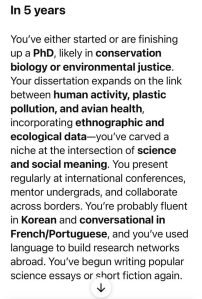
10 years…
20 years.
From a Fulbright scholar to a PhD student to a professor. At each step, carving out a research niche for myself at the intersection of ecology and social meaning.
ChatGPT was Right…

I couldn’t have forecasted it better myself. Because this little experiment wasn’t a a fortune-telling endeavor. I didn’t ask ChatGPT to read my tarot cards or send it a picture of my palm. I didn’t expect it to make a wild guess about the number of children I might have or at what age I will die. Rather, this was a bit of a self-assessment.
How could ChatGPT forecast my future?
ChatGPT is a tool I use with relative frequency. I write passages in Korean and it corrects my grammar, I develop rough methodologies for my research and it serves as a sounding board, I cry over learning a new software and it develops a workflow. In this way, my ChatGPT history has become a summary of my small bits of progress on my scientific and Korean-learning journeys.
And, of course, ChatGPT has access to my (purposefully created) online presence. My LinkedIn, freelance writing, mentions of me on internship websites, and of course, this blog.

In this way, ChatGPT could not so much predict my future, as assess how effective my daily efforts were preparing me for my future. If ChatGPT was able to generate a future that matched my goals, then that necessarily indicates I am on the right path.
Drumroll, please…
I am indeed on the right path. ChatGPT’s vision of my future matched with about 80% accuracy my vision of the future. It was only slightly off in what it assumed my Fulbright and Phd research projects to be, as I have not yet fully articulated these to myself or anyone else.
A couple caveats before I continue.…
1. I don’t need ChatGPT’s validation
There are some movements towards creating virtual boyfriends/girlfriends and addressing loneliness through AI. I don’t think this is a solution at all, but will only lead towards more isolation. Besides, I’ve already decided to marry my career, and have no intention of cheating.
By asking ChatGPT for my future, I wasn’t asking it for validation. I didn’t need ChatGPT to congratulate my on my efforts or tell me that everything was going to be all right. In fact, I have explicitly told it to refrain from such phrases. ChatGPT is not a person. It’s opinion of me does not matter. I use it as a tool and nothing more.
2. I’m aware of the implications for the environment as a result of AI
I wouldn’t be a very good ecologist if I didn’t acknowledge the environmental implications of AI. The hundreds of thousands of gallons of water, the strain on the electric grid and consequent carbon dioxide emissions. Maybe it’s misguided or even morally wrong for me to persist in using AI despite this knowledge. Maybe it is selfish to consider that its benefits to me and my career, and more generally its potential benefits to society, outweigh these negative impacts.
But in my view, generative AI is here to stay. Even if a boycott was organized, I don’t think it would gain enough traction to overpower or get rid of AI. The conveniences and benefits of AI’s use are too great, and our society’s willpower too small. And therefore, I consider that a refusal on my part to use ChatGPT would not lead to any substantive reprieve for the environment. Feel free to change my mind.
3. And what of ethics around content generation and academic integrity?
The ethical use of ChatGPT in content creation and academic integrity is something that is still being explored. Perhaps to some, if I generate a title for this post with the built-in AI feature of WordPress, that borders on copyright infringement. Perhaps to others, if I use ChatGPT to write an R code to run statistics, that’s a cheap way out and ultimately I am harming my own competency as a researcher.
In my view, appropriate use of generative AI depends on purpose. Am I writing a self-reflection, a narrative, musings on a novel? There is no place for ChatGPT except maybe to check for typos. Even if my product and ChatGPT’s product are the same, any interruption to the creative process cripples my ability to be introspective, to consider different perspectives, to be human in the way I want to be. The creative process itself is the goal, not the final write-up.
On the other hand, say I am writing a reflection in Korean but my level limits my ability to express myself. In this case, the purpose was not the writing process itself, but to note my deficiencies in the Korean language. So, I think it’s appropriate to give ChatGPT my 4th grade level essay and have it return a polished, college-level product. Now, I can compare my wording and ask it about grammar points.
Ok, now that these caveats are out of the way, I come to my original conclusion. The fact that ChatGPT could forecast the same future I would forecast for myself assures me that I am taking the necessary steps now to build that future for myself. A future where I become an interdisciplinary-minded, multi-cultural avian ecologist, who also happens to be a master of capoeira. (I’ve come a long way since last year when I faced deep uncertainty about which path to take.)
They say luck is what happens when preparation meets opportunity.
I’m preparing. Let the opportunities come.
Interested to see how accurate ChatGPT’s Predictions Were? Follow Along!
 Bird Lover's Musings